Kalshi vs. Polymarket: Which Prediction Market Should You Use in 2026?
/fit-in/64x64/1741092298/dusan.png "Dušan Jovanović")
/fit-in/64x64/1702479154/ioana-romanasu.jpg "Ioana Romanasu")
Prediction markets continue to grow rapidly in the US, and Kalshi and Polymarket are the two heavyweights, towering above the rest.
For some time, Kalshi has stood uncontested among American traders for its popular mention markets and consistent liquidity in headline markets. But then Polymarket re-entered the US after regulatory approval in late 2025, featuring crypto-native infrastructure and near-zero fees.
If you’re torn between which of these two platforms to choose, our detailed Kalshi vs. Polymarket comparison breaks down where each platform excels or falls short compared with the other one.
The Short Answer (TL;DR)
Kalshi and Polymarket both let you trade on real-world events, including sports, politics, financial outcomes, culture, crypto, and climate, but they take slightly different approaches under the hood.
You should use Kalshi for simplicity and fiat banking. Polymarket is a better option if you’re looking for scale, higher liquidity, crypto-driven trading, and low fees.
Kalshi vs. Polymarket: Quick Comparison Table
Before we go into details, here is a quick breakdown of both of these top US prediction market platforms.
| Feature | Kalshi | Polymarket |
|---|---|---|
| Referral Bonus | Trade $25 and Get $25 | Deposit $10 get a $25 Trading Bonus |
| Referral Code | WSN | WSN |
| Federal Regulation | CFTC regulated | CFTC regulated |
| Algorithmic Trading | Supported via open API | Supported via public APIs and blockchain smart contracts |
| Fees | $0.07 to $1.75 taker fees; $0.02 to $0.44 maker fees | 0.05% to 1.80% taker fees; no maker fees |
Regulatory Status: US Legality and State-Level Bans
Kalshi operates under the oversight of the Commodity Futures Trading Commission (CFTC), and its official website claims that its contracts are legal and accessible across 50 states.
That said, the regulatory picture has recently become a bit murky. In March 2026, Nevada issued a temporary ban on Kalshi, while Arizona accused the platform of offering unlicensed gambling. Additional legal pressure has emerged from Tennessee, Illinois, Connecticut, and Massachusetts, indicating a broader state-level pushback despite federal approval.
For Polymarket, the regulatory path has been even less straightforward. The platform was forced to exit the country in January 2022 following enforcement action by the CFTC, including a cease-and-desist order and a $1.4 million penalty for non-compliance.
After nearly four years of operating only internationally, Polymarket was finally approved by the CFTC and relaunched for US users in late 2025. But access remains limited, currently restricted to a waitlist for users who verify via a phone number.
At the same time, Polymarket has faced similar state-level resistance, with Tennessee issuing a cease-and-desist letter and Nevada pursuing legal action to block the platform.
Find more info in our comprehensive guide and get the definitive answer to the question: Are prediction markets legal in the US?
Kalshi vs. Polymarket Welcome Offers: Comparing the Bonuses
Kalshi and Polymarket welcome new users in very different ways. Kalshi's offer is a trading challenge, while Polymarket's works more like the deposit bonus you'd get at a sportsbook. Both pad your starting bankroll, but how you unlock the money suits different kinds of trader.
At Kalshi, new users get Trade $25 and Get $25 with Kalshi bonus code WSN. The reward is tied to how much you trade, not how much you deposit. To unlock the $25, you just need to trade $25 in total, and since contracts often cost only a few cents depending on the market, you can spread that across a lot of small positions. It's a low-stakes way to poke around the platform and get comfortable buying yes or no shares before putting real money on the line.
Polymarket goes bigger up front. With Deposit $10, Get $50 using Polymarket promo code WSN, you get a $50 bonus for a $10 deposit, a five-to-one boost that lands right away. Funding is straightforward too: Polymarket US takes standard methods like debit card, ACH, and Apple Pay, so you can claim the bonus without touching crypto.
So which is better? It comes down to your take on prediction market bonuses. Polymarket wins on plain value and asks less to get going, $10 deposited against Kalshi's $25 in trades, so for most people it's the stronger pick. Kalshi's edge is the learning curve rather than the payout: if you'd rather ease in with tiny contracts and feel out the markets first, its trade-and-get offer is a low-risk way to start.
Kalshi vs. Polymarket Comparison of Deposit Methods
Funding your account works differently on these two platforms. Kalshi will feel familiar if you’ve used sportsbooks or online casinos. It’s primarily fiat-based, with debit cards, e-wallets, and bank transfers, alongside some crypto options. There are the standard minimums and fees, but the process is straightforward.
On the other hand, Polymarket US keeps funding simple. It takes standard fiat methods like debit cards, ACH bank transfers, and Apple Pay, so there's no need to buy USDC or move crypto to a wallet. The process feels closer to a regular brokerage deposit than anything crypto-native.
Depositing on Kalshi
Kalshi lets you deposit via debit cards (including Apple Pay and Google Pay), e-wallets like PayPal and Venmo, ACH transfers, wire transfers, Cash App, and cryptocurrency. Crypto transactions are routed through Zero Hash, which handles conversion between crypto and USD.
Withdrawals are available through most of the same methods (excluding Cash App), with processing times typically around 30 minutes for faster options, while bank transfers can take up to three business days.
There are also security holds to consider. Card deposits carry a two-day hold before funds can be withdrawn to a different method (no hold if you withdraw to the same method), while ACH withdrawals are also subject to a two-day delay.
The funding process itself is simple. Just head to “Add Funds,” choose your method, and follow the guided steps.
Minimum deposit thresholds generally start at $10, although wire transfers require at least $1,000. Debit card deposits may come with fees of up to 2%, while crypto transactions incur only network fees and allow up to $500,000 per transfer. Withdrawals come with no internal fees. There are also dynamic daily withdrawal limits that tend to increase with account activity.
You can check our Kalshi review for more details about deposits.
Depositing on Polymarket US
Polymarket US funds through standard US payment methods, not crypto. You can deposit with a debit card, ACH bank transfer, wire, or Apple Pay, and there's no need to buy USDC, pick a network, or manage a wallet address.
Deposits are generally instant for trading, though full clearance for withdrawal can take a few business days. Minimums start around $10, and to claim the welcome offer you need to deposit at least $10 using promo code WSN.
To add funds, select "Deposit," choose your method, enter an amount, and confirm. Withdrawals follow the same path back to your linked method.
For more details, see our Polymarket review.
Kalshi vs. Polymarket Market Variety: What Can You Trade On?
Polymarket tends to stand out at first glance for its sheer scale and market segmentation. While both platforms cover core categories like sports, politics, economics, climate, culture, and more, Polymarket breaks them down further, separating esports from traditional sports and geopolitics from broader political markets, so navigation is a bit more granular and expansive.
However, depth isn’t always one-sided. When comparing a single NBA matchup, Polymarket offers the expected lines, such as moneyline, spreads, and totals, plus first-half markets and key player props like points, rebounds, and assists. Kalshi matches all of that and goes further, adding niche player props like double-doubles, triple-doubles, three-pointers, and even second-half winner markets.
Soccer tells a different story. In a UEFA Champions League fixture comparison, Polymarket proved more comprehensive, covering exact scorelines, goalscorers, both teams to score, corners, and half-time results. Meanwhile, Kalshi doesn’t offer exact scores or goal scorers.
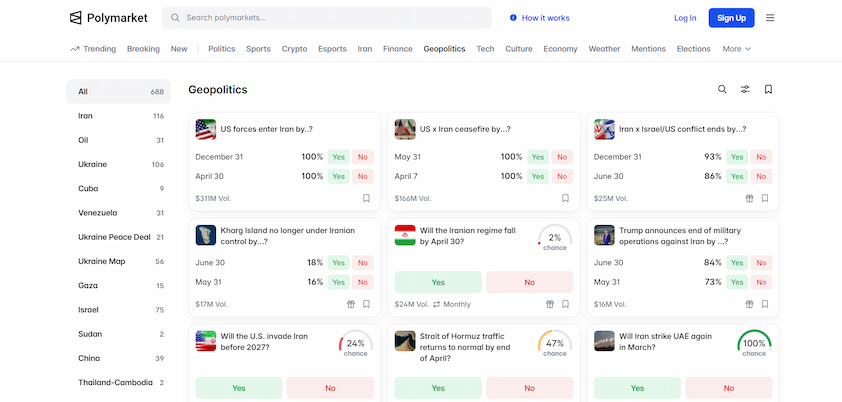
When it comes to politics, both platforms are well-stocked but differ in approach. In the midst of the current global political turmoil, Kalshi allows you to predict the time of Donald Trump’s visit to Iran, while Polymarket features speculation on whether the Iranian regime will fall by the given date. When it comes to global elections, you’ll find wider coverage on Polymarket, which lists over 130 active markets compared to roughly half that on Kalshi.
Polymarket also shows greater depth in niche categories like weather and natural events, with dedicated subsections for earthquakes, tornadoes, and volcanic activity. Kalshi covers similar ground but groups these into a single category, resulting in fewer total listings.
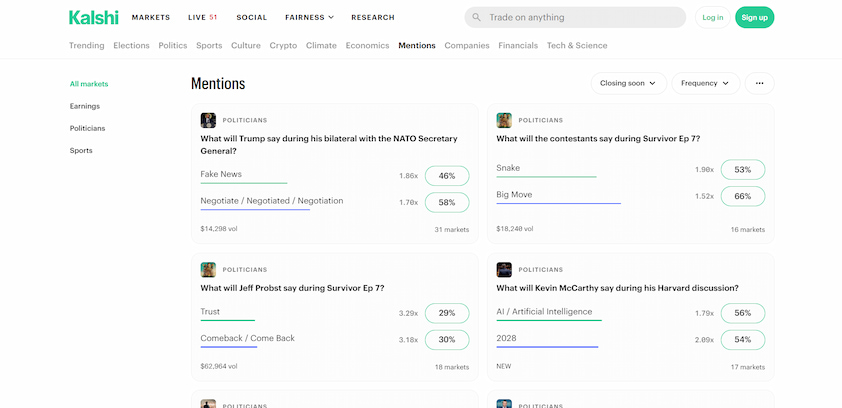
Mention markets are one of Kalshi’s signature offerings, and it has an edge over Polymarket in that area, with more niche choices. For instance, you can predict what sports announcers will say in a given game, which is something you’ll struggle to find anywhere else. Polymarket usually sticks to politics here, but it sees more trade volume around popular mentions. At the time of this review, liquidity for what Trump might say in his next speech ran at around $8k on Kalshi, while the same speech on Polymarket had a volume of $35k.
Kalshi also has a distinct advantage in financial markets. It offers a wide range of contracts tied to assets such as commodities, treasury yields, and indices, including the NASDAQ Composite. Polymarket covers some of these areas as well, but with fewer variations overall.
Popular Prediction Market Events
/fit-in/608x342/1791189206/which-party-will-win-the-senate.jpg)
Which Party Will Win the Senate? 2026 Prediction Market Odds
1 week ago | Bryan Zarpentine/fit-in/400x235/1791876187/georgia-senate-odds-2026.jpg)
Iowa Senate Odds 2026: Ashley Hinson vs. Josh Turek Predictions
1 week ago | Bryan Zarpentine
Georgia Senate Odds 2026: Jon Ossoff vs. Mike Collins Predictions
1 week ago | Bryan Zarpentine/fit-in/400x235/1791469926/ohio-senate-odds-2026.jpg)
Ohio Senate Odds 2026: Sherrod Brown vs. Jon Husted Predictions
1 week ago | Bryan ZarpentinePricing Inefficiencies and Arbitrage
When comparing Kalshi vs. Polymarket, keep in mind you don’t have to choose just one. Using both platforms in parallel can create opportunities, particularly for spotting pricing inefficiencies that could lead to potential arbitrage setups.
Because prices on each platform are driven independently by user demand, the same contract can occasionally trade at slightly different levels. When you spot a gap, you can take opposing positions on each platform to lock in a guaranteed return.
For example, if “Yes” shares trade at 45¢ on Kalshi while “No” shares on Polymarket are priced at 52¢, your total cost is 97¢. Since each contract settles at $1, that creates a 3¢ guaranteed profit per contract regardless of the outcome.
While individual margins may seem insignificant, they can add up over multiple trades.
However, this strategy isn’t as straightforward as it sounds. True arbitrage opportunities are rare, especially in high-liquidity markets where prices quickly align. You’ll often need to explore niche contracts that exist on both platforms, while hoping for enough liquidity between them. Trading fees and withdrawal charges may also eat into your profit margins, while the need to keep capital split across two platforms with different payment structures is inherently inconvenient.
In practice, arbitrage between Kalshi and Polymarket can be profitable, but it’s not easy money. It requires a lot of time and discipline, so it’s more of a useful edge for experienced users than a guaranteed strategy for everyone.
The Verdict: Which Platform is Better?
When it comes down to it, Kalshi is the overall winner. The deciding factor is simple: you can actually sign up and start trading on Kalshi right now, whereas Polymarket is still restricted to an invite-only waitlist.
Kalshi is the better choice for traditional retail: You’ll have an easier onboarding process with no waitlists and can use fiat banking methods while having access to the platform’s signature mention markets and a wide range of financial events.
Polymarket is a clear winner for liquidity and variety: With Polymarket, you get a broader overall market selection with better segmentation and a deeper selection of niche events. It typically delivers higher liquidity on major contracts, while its lower-fee model and blockchain-based infrastructure enable fast, low-cost transactions within its native ecosystem.
Frequently Asked Questions (FAQ)
Which platform has higher trading volume: Kalshi or Polymarket?
Are Kalshi and Polymarket the exact same thing?
Which prediction market has lower fees: Kalshi or Polymarket?
Can I hold accounts on both Kalshi and Polymarket at the same time?
Do Kalshi and Polymarket offer the exact same event contracts?
Top Prediction Market Reviews
/fit-in/400x235/1773152882/og-prediction-market-review.jpg)
OG Prediction Market Review 2026 - Trade $25 and Get $25 in Rewards with Promo Code WSN
1 month ago | Stefan Nedeljković/fit-in/400x235/1771495622/crypto.com-prediction-market-review.jpg)
Crypto.com Prediction Market Review 2026 – Get up to $50 in CRO When Signing Up
1 week ago | Stefan Nedeljković/fit-in/400x235/1773314080/novig-prediction-market-review.jpg)
Novig Prediction Market Review 2026: Is Novig Legit?
1 week ago | Stefan Nedeljković/fit-in/160x160/1741092298/dusan.png "Dušan Jovanović logo")
Dušan Jovanović
iGaming Industry Specialist
| Email: | dusan.jovanovic@wsn.com |
|---|---|
| Nationality: | Serbian |
| Education: | School of Economics |
| Favourite Sportsbook: | FanDuel |
| Favourite Casino: | BetRivers |
| Experience: | 8+ years |






/1773392173/dmca-image.png "DMCA")
/1670944202/21.png "21")
/1670944628/2022-igb-best-casino-affiliate-gig-media-e1651053747946.png "2022 igb best casino affiliate gig media e1651053747946")
/1670944701/gig-media-power-affiliates-rank-123x40-1.png "Gig media power affiliates rank 123x40 1")
/1670944773/800-gambler-black-144x40.jpg "800 gambler black 144x40")