Kalshi vs. Robinhood: Which Platform is Better for US Event Contract?
/fit-in/64x64/1742215299/stefan-nedeljkovi%C4%87.png "Stefan Nedeljković")
/fit-in/64x64/1702479154/ioana-romanasu.jpg "Ioana Romanasu")
Prediction markets aren’t tucked away in some backroom corner of finance anymore. In 2026, US traders can take positions on sports results and real-world events such as elections, Fed decisions, inflation reports, crypto prices, culture, and education.
Instead of waiting for headlines to move stocks, bonds, or crypto, event contracts let you trade directly on whether a defined outcome happens.
Kalshi and Robinhood are two of the most talked-about names in this space. However, they entered the prediction market boom from different doors. Both give eligible users access to CFTC-regulated contracts, but their market infrastructures differ.
In fact, Kalshi vs. Robinhood is a depth-versus-convenience call. Kalshi is the stronger overall prediction market platform because it offers more markets, better trading tools, more control over order execution, stronger sports coverage, and more favorable fees for active traders. Robinhood is geared toward users who want no deposit fees and mainstream contracts inside an easy-to-use app rather than an advanced trading environment.
The Short Answer (TL;DR)
Kalshi and Robinhood both let eligible US users trade Yes/No event contracts, but they are not built around the same prediction market ecosystem.
Kalshi is a dedicated event contract exchange with a broader, more granular market menu.
Robinhood offers a more curated version of event trading inside its regular brokerage app.
That structure creates two different trading experiences. Kalshi is a standalone, CFTC-designated contract market, so the platform is built around event contracts from the ground up. In other words, it runs its own event contract exchange instead of sending users elsewhere to trade. This gives Kalshi more room to offer specialized markets, full order books, open API access, and a maker/taker fee model built for active traders.
Robinhood brings event contracts into the same brokerage app people already use for stocks, ETFs, options, and crypto. It doesn’t run the event contract marketplace itself. Instead, it routes certain contracts through CFTC-regulated partner exchanges such as KalshiEX LLC.
The biggest practical difference is control. Kalshi gives you more ways to work an order, compare pricing, trade niche markets, and reduce costs through maker fees. Robinhood is built for everyday traders who want event contracts inside a familiar app, with a more curated market list and fewer advanced controls than Kalshi. It still supports useful order features like GTD limit orders and partial fills, but the overall experience is more guided.
Although Kalshi has a more diverse market selection overall, Robinhood has a few categories that Kalshi doesn’t, including education markets such as tuition-related contracts.
Kalshi vs. Robinhood comparison: Quick Reference Table
Here’s a quick side-by-side look at how Kalshi and Robinhood compare on regulation, fees, bonuses, API access, sports markets, banking options, and the type of trader each platform serves best.
| Feature | Kalshi | Robinhood Event Contracts |
|---|---|---|
| Referral Bonus | Refer a friend, and both of you receive $25 after the referred user signs up through your link and completes the trading requirements. | Invite a friend, and you both receive gift stock after the referred user signs up and meets Robinhood’s requirements. |
| Welcome Bonus | Trade $25 and Get $25 | New users get a free stock after account approval and linking a bank account or debit card. Most users receive a $5 stock, while smaller groups receive $10 or $200 stock rewards. |
| Bonus Code | WSN | N/A |
| Federal Regulation | CFTC-regulated as a standalone, CFTC-designated contract market. | CFTC-regulated access through Robinhood Derivatives and partner exchanges, including KalshiEX LLC for certain contracts. |
| Algorithmic Trading | Supported through Kalshi’s open API for market data and trade execution. | Not supported for event contracts. |
| Fees | Probability-based maker/taker fees. Taker fees range from $0.0007 to $0.0175 per contract. Maker fees range from $0.0002 to $0.0044 per contract. | Probability-weighted commission is calculated as k × P × (1 − P) × C, so the fee peaks near $0.50 and drops toward $0.01 or $0.99. The constant (k) is 10% for standard users and 5% for Robinhood Gold ($5/month). Robinhood caps its own commission at $0.01 per contract, and the exchange adds up to $0.01, for a maximum of about $0.02 per contract. |
| Best for | Traders who want deeper markets, better fees, API access, sports props, broader banking options, and more execution control. | Users who want a simpler app experience, no deposit fees, and quick access to mainstream event contracts. |
Regulatory Status: US Legality and CFTC Oversight
Event contracts on Kalshi and Robinhood fall under federal derivatives regulation. The key regulator is the Commodity Futures Trading Commission, or CFTC, which oversees US futures, swaps, and designated contract markets.
Both platforms are federally regulated, but they operate from very different positions within that framework.
KalshiEX LLC is a CFTC-designated contract market, which means Kalshi can list and operate event contracts under the Commodity Exchange Act and CFTC rules. In plain terms, Kalshi is not merely giving users access to event contracts, it also runs the exchange where those contracts trade.
Robinhood Derivatives, the entity behind the prediction markets feature, is the customer-facing access point, while the underlying contracts are cleared through third-party regulated exchanges, including KalshiEX LLC.
Even though both platforms are CFTC-regulated, that hasn't kept state regulators from taking a swing at them, especially over sports contracts. Namely, several states have pushed back on contracts tied to team results, player performance, and tournament outcomes, saying they look more like sports betting than financial event contracts.
Connecticut ordered Kalshi, Robinhood Derivatives, and Crypto.com to stop offering sports-related prediction markets, claiming those contracts amounted to unlicensed sports wagering under state law.
New Jersey and Nevada have taken similar action. New Jersey sent cease-and-desist letters to Kalshi and Robinhood over sports markets, while Nevada litigation led to rulings affecting both Kalshi and Robinhood’s ability to offer sports contracts in the state.
Massachusetts has been another major pressure point. The state attorney general sued Kalshi over sports-related event contracts, and a court order blocked Kalshi from offering those contracts in Massachusetts while the case continues.
Arizona took the fight even further by filing criminal charges against Kalshi. The state accused the platform of violating Arizona gambling laws through contracts tied to political outcomes, college sports, and player performance. Kalshi rejected the charges, saying its contracts belong under federal CFTC oversight.
The CFTC hasn't sat on the sidelines either. In 2026, the agency sued multiple states, including Wisconsin, New York, Connecticut, and Illinois, saying state regulators are interfering with federally regulated prediction markets. The CFTC’s position is that Congress gave it exclusive jurisdiction over event contracts traded on designated contract markets.
Right now, traders should treat event contracts on Kalshi and Robinhood as federally regulated financial products, while viewing sports event contracts as part of the market that has been most exposed to state-level challenges. This regulatory safety also extends to how these platforms reward users, often resulting in the best prediction market bonuses and fee-waiver structures for new accounts.
Kalshi vs. Robinhood Welcome Offers
The bonus structures available on Kalshi and Robinhood are shaped entirely by their underlying business models. Because Kalshi operates purely as a designated contract market, its promotional strategy targets direct exchange liquidity. Robinhood, by contrast, operates its prediction feature as an extension of its traditional retail brokerage, meaning new users are pulled into a much broader financial ecosystem from day one.
For traders looking to get started on Kalshi, the platform utilizes a trade-based incentive rather than a standard deposit match. New Kalshi accounts can unlock the "Trade $25 and Get $25" offer on the exchange when signing up with Kalshi promo code WSN. Given that event contracts are priced between $0.01 and $0.99 based on probability, clearing this $25 trading threshold does not require an intensive capital outlay. Instead, this structure is designed to build familiarity with the order book, encouraging traders to gain hands-on experience setting limit orders and managing spreads across politics, climate, or sports prop markets.
Robinhood does not offer a dedicated prediction market promotion, choosing instead to route all new users through its flagship equity sign-up reward. Upon opening an account and linking a valid payment method, users receive a fractional stock reward valued anywhere from $5 to $200. While the vast majority of participants will land on the lower end of that spectrum, the promotion requires no upfront trading activity to execute. Once the gift stock lands in the account, it can be liquidated after a brief three-day holding period, allowing traders to redirect those cash proceeds straight into the Robinhood Prediction Markets Hub.
Evaluating which platform has the better prediction market bonus depends heavily on whether you prioritize immediate equity or active trading practice. Robinhood provides a low-barrier entry because the gift stock lands automatically without a strict trading requirement, making it a comfortable option for casual users who already plan to navigate multiple asset classes. For specialized event traders who want a promotion that directly rewards high-frequency positioning on a full-scale exchange, Kalshi's volume-based model provides the more practical playground for testing strategies.
Market Variety: Breadth vs. Curation
Kalshi wins the market-variety matchup because it offers traders more ways to price the same broad idea. Robinhood focuses on the bigger, easier-to-scan markets, but Kalshi cements its status among the best prediction markets by giving you more contract types, more time frames, and more ways to build a position inside the same category.
If you want a good feel for how far apart these two platforms are regarding market depth, sports is a good place to start. As detailed in our full Robinhood review, the platform covers esports and 14 traditional sports, with markets running through game winners, totals, spreads, futures, playoff series, draft markets, awards, and specials.
Kalshi offers trading options across esports and 19 traditional sports. However, the difference isn’t just the number of sports available. Unlike Robinhood, Kalshi offers various props markets, including NBA team total points, player points, and other team- or player-level contracts.
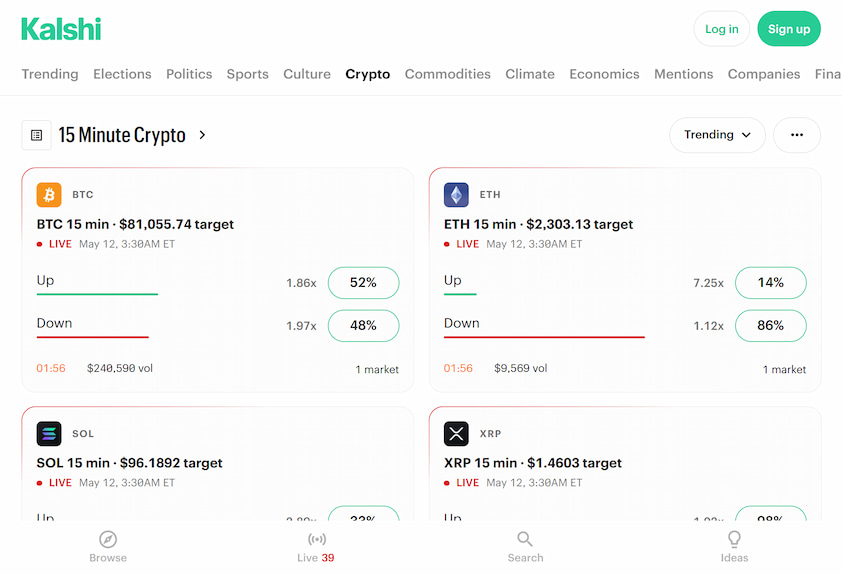
Within the broader landscape of fiat vs crypto prediction markets, the way each platform structures its digital asset contracts varies significantly. As for crypto markets, Robinhood offers major coins such as BTC, ETH, SOL, and several other cryptocurrencies, mostly through broader price markets.
As for crypto markets, Robinhood offers major coins such as BTC, ETH, SOL, and several other cryptocurrencies, mostly through broader price markets.
Kalshi gives crypto traders more ways to time the trade. It covers a wider list of coins, including lesser-known names such as Shiba Inu, and breaks markets into 15-minute, hourly, daily, weekly, monthly, annual, and one-time contracts. For traders, the extra timing options create more room to make short-term moves instead of only taking a bigger-picture price view.
Crypto: Robinhood offers major coins such as BTC, ETH, SOL, and several other cryptocurrencies, mostly through broader price markets. Kalshi gives crypto traders more ways to time the trade. It covers a wider list of coins, including lesser-known names such as Shiba Inu, and breaks markets into 15-minute, hourly, daily, weekly, monthly, annual, and one-time contracts. For traders, the extra timing options create more room to make short-term moves instead of only taking a bigger-picture price view.
Climate: This is another category where Kalshi boasts more depth. Robinhood has weather-style markets such as temperature and rainfall, which works fine for quick, simple calls. Kalshi gives traders a wider weather and climate trading pool. Traders can price daily temperature, hourly temperature, hurricanes, natural disasters, snow, rain, and climate change outcomes. The extra depth creates more ways to trade city-level forecasts, storm risk, and specific weather events instead of only making a basic temperature or rainfall call.
Tech and Science: These overlap on both platforms with AI and space markets, but Kalshi expands into energy and medicine. Contracts around nuclear reactor licensing, FDA approvals, biotech filings, compute pricing, and EV market share offer more options for traders who follow policy, regulation, and sector-specific news.
Elections: Kalshi’s election coverage runs across more countries, including Wales, Scotland, Peru, Brazil, Hungary, and other races. It also breaks politics into more specific subcategories, so you can trade something more targeted than the main national result. Robinhood also offers international markets for places like Brazil and Hungary, but the list is much shorter.
Entertainment: Even though entertainment is more balanced, Kalshi still has a wider range. The markets here include movies, music, awards, collectibles, people, television, and video games, plus more granular contracts around shows, charts, ratings, and cultural moments. You’ll find all these markets under Culture. Robinhood covers TV, movies, Rotten Tomatoes, video games, and music.
Mentions & Education: Kalshi's mentions markets are worth flagging separately. These contracts let traders take positions on what public figures, politicians, or media personalities will say during specific broadcasts or events, and there's no equivalent on Robinhood's side. However, education is the one category Robinhood lists that Kalshi doesn't. Traders can make predictions on real-world tuition outcomes, with contracts like UCLA out-of-state tuition for 2026 on the menu. It's a niche Kalshi hasn't gotten around to yet.
Popular Prediction Market Events
/fit-in/608x342/1791272230/texas-senate-odds-2026.jpg)
Texas Senate Odds 2026: James Talarico vs. Ken Paxton Prediction Markets
3 hours ago | Bryan Zarpentine/fit-in/400x235/1791189206/which-party-will-win-the-senate.jpg)
Which Party Will Win the Senate? 2026 Prediction Market Odds
3 hours ago | Bryan Zarpentine/fit-in/400x235/1791193930/2026-midterm-election-predictions.jpg)
2026 Midterm Election Predictions: Who Will Control Congress?
1 day ago | Bryan Zarpentine/fit-in/400x235/1780478899/who-will-win-the-us-house-prediction-market.jpg)
Midterm Election Odds: What Prediction Markets Say About Control of the U.S. House
1 week ago | Grant MitchellPlatform Tools and Order Execution
Kalshi is more feature-rich than Robinhood, which provides traders with more flexibility once they start managing positions. The platform gives you more pricing context, execution control, and ways to read how a market is moving before you enter or exit.
Robinhood keeps the experience lighter. This makes it easier for beginners and intermediate users, but it also means there are fewer advanced tools for traders who want to dig into liquidity, order depth, API access, and price movement.
Retail UI vs. Full Order Book
Robinhood is easier to get started with. Thanks to the activity chart, a simple contract screen, and a guided order flow included in the interface, you can go through the process without prior knowledge of how prediction markets work.
As highlighted in our Kalshi review, the exchange provides much more market detail through its full order book. Buyers’ bids, sellers’ asking prices, and the amount available at each price are entirely visible before an order is placed. This way, traders gain a better read on liquidity, see the gap between buy and sell prices, and understand how quickly the contract price could move. Something worth noting here is that, when they do move quickly, the order book can help you avoid taking a bad price.
API Access and Algorithmic Trading
Kalshi has a major edge over Robinhood for advanced and quantitative traders. It supports open API access for market data and trade execution, and developers can build tools around live pricing, news triggers, and automated trading rules.
For example, a trader can build a bot to scan economic releases, weather updates, injury reports, or breaking news, then send orders when a contract price moves outside a target range.
Robinhood does not support API trading for event contracts. Users trade through the app, which keeps the product simple but limits advanced strategies.
For traders who want custom alerts, automated execution, or data-driven models, Robinhood is not such a good fit. It works better for manual trading on a smaller list of high-interest contracts.
Limit Orders and Slippage
A limit order lets you set the maximum price you're willing to pay or the minimum you'll accept when selling, which protects you from slippage when a contract starts swinging. Slippage is the difference between the price you targeted and the price at which your order actually executed. It can happen when liquidity is thin, the market moves fast, or there aren’t enough contracts available at your target price.
Kalshi and Robinhood both offer limit order functionality, but Kalshi gives you more context before you place one. Since you can see the full order book, you can check how many contracts are available near your price and decide whether to wait, adjust, or split your order.
Robinhood supports GTD (“good till date”) limit orders and partial fills. As a result, the order stays active until a set expiration date unless it goes through or the user cancels it. Partial fills mean only part of the order goes through, which happens if there aren’t enough contracts available at the limit price.
The main difference in how both platforms handle limit orders comes down to pre-trade visibility. Kalshi gives traders more detail before setting a limit order, which helps when price, size, and timing all matter. Robinhood offers a simpler version that works well for smaller trades but gives active users less control over execution.
Trading Fees and Contract Pricing
Robinhood switched to a probability-weighted commission model on June 1, 2026, moving away from a single flat fee on every trade. For each contract, the formula is:
Commission = k × P × (1 − P) × C
Here, C is the number of contracts, P is the contract price in dollars (so a 50¢ contract counts as 0.50), and k is the fee constant. Standard users get a 10% constant, while Robinhood Gold members ($5 per month) get 5%. Robinhood caps its own commission at $0.01 per contract, and the exchange, such as KalshiEX LLC or another partner, can add up to $0.01, for a maximum of about $0.02 per contract.
Kalshi uses its own probability-based fee formula. For taker orders, the formula is:
Fees = round up (0.07 × C × P × (1 − P))
For maker orders, it goes like this:
Fees = round up (0.0175 × C × P × (1 − P))
C means the number of contracts. P stands for the contract price in dollars, so a 50¢ contract counts as 0.50. "Round up" means the fee gets rounded up under Kalshi's fee calculation.
In per-contract terms, Kalshi's taker fee ranges from about $0.0007 to $0.0175. Kalshi's raw maker fee ranges from about $0.000175 to $0.004375 per contract before rounding up. In practice, Kalshi rounds the total order fee up to the next cent, so the real amount depends on contract count and price. For 100 maker contracts, the fee is roughly $0.02 to $0.44.
Both platforms now price fees the same way at their core. The cost is highest when a contract trades near 50¢, where the outcome is closest to a toss-up, and lowest near 1¢ or 99¢, where the market already leans heavily one way.
The difference is in the details. Kalshi's maker/taker split rewards active traders. A taker accepts an existing price from the order book, while a maker posts an order and waits for another trader to accept it, and Kalshi charges makers less because those orders add liquidity. Robinhood doesn't separate maker and taker pricing, so the way to cut costs there is a Gold membership, which halves the constant from 10% to 5%.
On a straight per-contract comparison, Kalshi is cheaper across most price points for standard Robinhood users, and the advantage grows the more actively you trade as a maker. Robinhood Gold narrows the gap, but Kalshi's maker rates still come out ahead for high-volume traders.
The Verdict: Which Kalshi vs. Robinhood Prediction Market Fits Your Strategy?
Kalshi is the better fit if you want more control, more contract variety, and a platform built around event trading. If you want a lighter first pass, with less market depth to read and a simpler path to placing a Yes/No trade, then Robinhood is the way to go.
Use Robinhood if you want the easiest first trade. Robinhood strips the experience down compared to Kalshi. There’s no full order book to read, and there are fewer markets to sort through, which can make the first Yes/No trade easier for users who just want a simple entry point.
Use Kalshi if you care about execution precision. Full order books, visible price levels, and deeper market data give you a better read on where buyers and sellers are before you place an order.
Use Robinhood Gold if you trade often. Robinhood prices trades on the same probability-weighted formula as Kalshi, and the Gold membership ($5/month) cuts the fee constant from 10% to 5%. For an active trader putting up regular volume, that halved rate takes a real bite out of your costs.
Use Kalshi if trading costs matter more than simplicity. Kalshi’s probability-based maker/taker model can be much cheaper for active users, especially when you post orders instead of taking the current price.
Use Robinhood if you mostly trade mainstream markets. It works best for major sports, politics, crypto, economics, and culture contracts where a curated menu is enough.
Use Kalshi if you want the wider contract shelf. Kalshi is stronger for sports props, international elections, crypto time windows, climate categories, mentions markets, and more granular entertainment contracts.
Use Kalshi if you want a platform you can scale into. API access, advanced order visibility, broader banking options, and a deeper exchange toolkit make it a stronger long-term platform for serious prediction market traders.
Frequently Asked Questions
Are event contracts legal on both Kalshi and Robinhood?
Does Robinhood offer as many prediction markets as Kalshi?
Can I build a trading bot for Robinhood event contracts?
How do taxes work on prediction markets?
Top Prediction Market Reviews
/fit-in/400x235/1773060646/polymarket-prediction-market-review.jpg)
Polymarket US App Review October 2026 - Deposit $10 get a $25 Trading Bonus
20 hours ago | Stefan Nedeljković/fit-in/400x235/1771495622/crypto.com-prediction-market-review.jpg)
Crypto.com Prediction Market Review 2026 – Get up to $50 in CRO When Signing Up
2 months ago | Stefan Nedeljković/fit-in/400x235/1773152882/og-prediction-market-review.jpg)
OG Prediction Market Review 2026 - Trade $25 and Get $25 in Rewards with Promo Code WSN
3 weeks ago | Stefan Nedeljković/fit-in/160x160/1742215299/stefan-nedeljkovi%C4%87.png "Stefan Nedeljković")
Stefan Nedeljković
iGaming Industry Specialist
| Email: | stefan.nedeljkovic@wsn.com |
|---|---|
| Nationality: | Serbian |
| Education: | Faculty of Science and Mathematics |
| Favourite Sportsbook: | FanDuel |
| Favourite Casino: | BetMGM |
| Experience: | 8+ years |






/1773392173/dmca-image.png "DMCA")
/1670944202/21.png "21")
/1670944628/2022-igb-best-casino-affiliate-gig-media-e1651053747946.png "2022 igb best casino affiliate gig media e1651053747946")
/1670944701/gig-media-power-affiliates-rank-123x40-1.png "Gig media power affiliates rank 123x40 1")
/1670944773/800-gambler-black-144x40.jpg "800 gambler black 144x40")