Polymarket vs. Robinhood: Which Platform Dominates the US Event Contract Scene in 2026?
/fit-in/64x64/1741092298/dusan.png "Dušan Jovanović")
/fit-in/64x64/1702479154/ioana-romanasu.jpg "Ioana Romanasu")
The prediction market craze is hitting its peak in 2026, giving users more ways than ever to trade on elections, sports, economics, crypto, and various cultural and political events.
Choosing between two platforms like Polymarket vs. Robinhood now comes down to far more than just available markets. Traders are now comparing liquidity, fees, available trading tools, ease of use, payment methods, and overall trading experience to decide which platform is the right fit.
Both Polymarket and Robinhood are CFTC-regulated, but their approaches to prediction markets differ:
Polymarket built its reputation as the crypto-native pioneer, known for deep liquidity, fast-moving order books, and a broad range of niche contracts. After returning to the US in late 2025 through a regulated structure, it once again became a major force for experienced American traders looking for variety and depth.
Robinhood’s primary goal is simplicity. Its prediction markets hub primarily focuses on mainstream events and offers one of the easiest entry points for beginners looking to trade event contracts.
Polymarket vs. Robinhood Comparison: Quick Reference Table
Here’s a quick look at how Polymarket and Robinhood compare in terms of features, regulation, and fees, along with a brief statement on which platform suits which type of user. Both platforms also offer competitive welcome packages that stand out as some of the best prediction bonuses on the market right now.
| Feature | Polymarket | Robinhood (Event Contracts) |
|---|---|---|
| Welcome Bonus | Deposit $10 get a $50 Trading Bonus | Gift stock credit between $5 and $200. The gifts are random, and most new users receive the $5 gift, with only a fraction of traders getting the maximum $200 reward |
| Promo Code | WSN | - |
| Federal Regulation | CFTC Regulated | CFTC Regulated |
| Algorithmic Trading | Supported via public APIs and blockchain smart contracts | Not supported |
| Fees | Dynamic taker fees up to 1.80% depending on the market and contract price; no maker fees | Probability-weighted commission where Gold subscribers pay half the usual rate |
| Best For | Traders seeking market depth, API access, and more execution control | Beginner traders looking for a simple interface and easy access to headline events |
Regulatory Status: US Legality and CFTC Oversight
While both Polymarket and Robinhood are regulated by the Commodity Futures Trading Commission (CFTC) at the federal level, we need to take a closer look at what that actually means for each platform and how recent state-level pressure affects their nationwide availability.
Robinhood prediction markets operate through federally regulated infrastructure tied to KalshiEX LLC, a CFTC-designated contract market (yes, the same company behind Kalshi prediction markets). Robinhood itself is not running the exchange; instead, it acts as a simplified front-end that gives users access to regulated event contracts already listed by approved entities.
Meanwhile, Polymarket spent years outside the US regulatory framework. The platform exited the American market in 2022 following a CFTC enforcement action that resulted in a cease-and-desist order and a $1.4 million settlement for offering unregistered event contracts. After operating internationally for several years, Polymarket re-entered the US market in late 2025 under a regulated structure that enabled it to legally offer contracts to American users again.
For several months, Polymarket limited access for US users via a waitlist, which is no longer in effect as of May 12, 2026.
Despite both platforms cementing their status among the best prediction markets and operating under CFTC supervision, neither has escaped state-level scrutiny. Several states, including Nevada, Connecticut, New Jersey, Arizona, and Massachusetts, have challenged sports-related event contracts, arguing that they fall under state gaming laws rather than solely federal derivatives regulation.
Robinhood has largely been drawn into those disputes through its partnership with Kalshi. It currently lists Maryland as unavailable, while Nevada users face restrictions on sports contracts.
/fit-in/80x80/1741092298/dusan.png)
Popular Prediction Market Events
/fit-in/608x342/1780478632/democratic-nominee-2028-prediction-market.jpg)
Who Will Become the 2028 Democratic Nominee? Presidential Election Prediction Markets Have Their Say
2 weeks ago | Grant Mitchell/fit-in/400x235/1780478899/who-will-win-the-us-house-prediction-market.jpg)
Which Party Will Win the U.S. House? Political Prediction Markets Have Their Say
2 weeks ago | Grant Mitchell/fit-in/400x235/1780479022/us-presidential-election-2028-prediction-market.jpg)
Who Will Win the 2028 U.S. Presidential Election? Political Prediction Markets Are Tracking the Race
2 weeks ago | Grant Mitchell/fit-in/400x235/1780479178/california-gubernatorial-election-prediction-market.jpg)
2028 California Governor Prediction Markets to Replace Newsom
2 weeks ago | Grant MitchellMarket Variety: Breadth vs. Curation
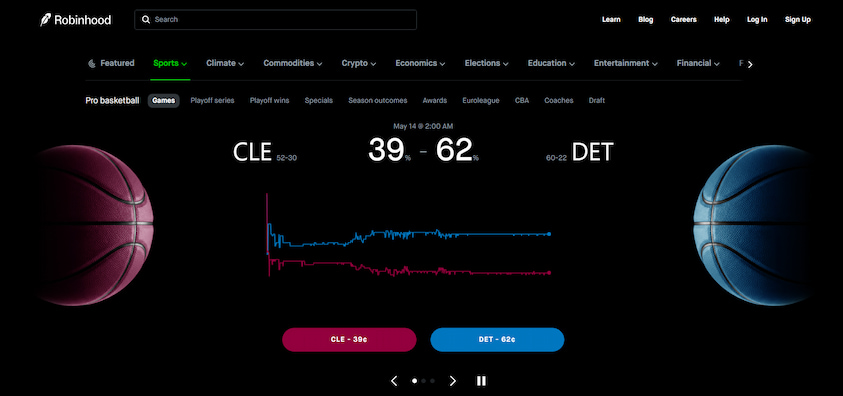
Polymarket clearly leads in sheer market variety and depth. Robinhood takes a far more curated approach, keeping its prediction markets streamlined and beginner-friendly by limiting the number of contracts in each category.
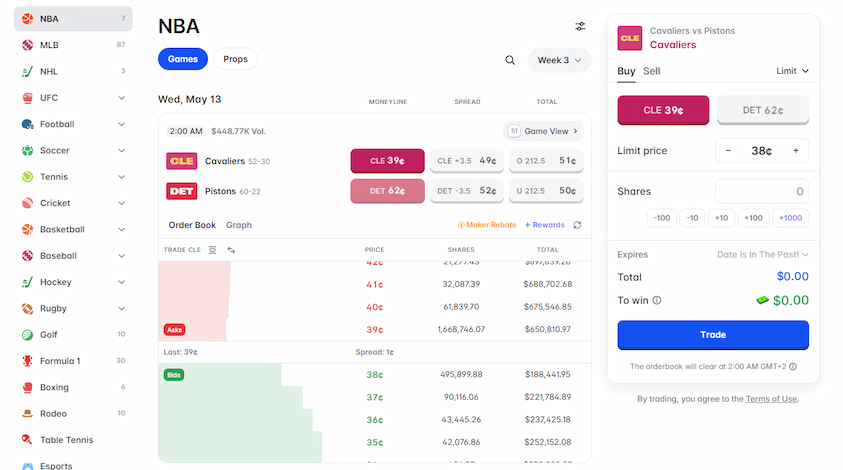
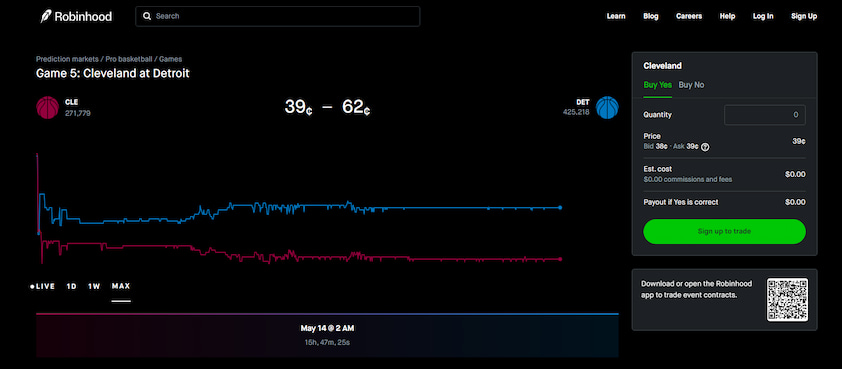
Sports: Taking a playoff NBA game between Cleveland and Detroit as an example, Robinhood sticks to just picking the winner. Meanwhile, that same matchup on Polymarket expands further into point spreads, totals, first-half winner, and player-specific markets tied to points, rebounds, and assists.
Crypto: Polymarket offers predictions across multiple timeframes, ranging from 5-minute and 15-minute windows to hourly, monthly, and even yearly outcomes. Robinhood keeps things much simpler, generally focusing on broader short-term directional movements within daily or 15-minute time windows.
Climate: Robinhood primarily focuses on major US cities and straightforward forecasts, such as daily temperatures or monthly rainfall. Polymarket goes much deeper, covering everything from tornado activity and earthquakes to global-scale questions such as whether 2026 will become the hottest year on record.
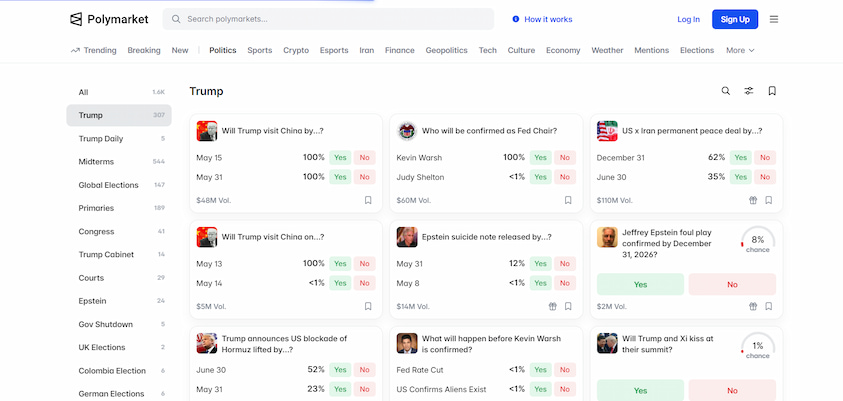
Politics: As we highlighted in our dedicated Polymarket review, this is arguably Polymarket’s biggest strength. The platform features over 1,500 active options at any given time, segmented into niche categories (including over 300 Trump-related markets). Robinhood mostly focuses on local US elections and around a dozen Trump-related markets, keeping international elections brief with only one or two major countries at a time.
Entertainment: Polymarket’s “Culture” section spans movies, celebrities, music, awards shows, reality TV, gaming, and highly unconventional topics (e.g., confirming the existence of aliens). Robinhood splits entertainment into broad, concise categories like TV, Movies, Rotten Tomatoes, Music, and Video Games, with only a handful of options for each.
Platform Tools and Order Execution
Choosing between Polymarket and Robinhood in terms of order execution and platform tools largely depends on your trading experience and the level of visibility and control you want.
Order Books vs. Simple UI
At Polymarket, every market shows live bids and asks, letting users see exactly where liquidity sits at each price level. This gives traders a clearer sense of depth and helps them anticipate how quickly a contract will move when larger orders enter the market. The visible order book allows you to place limit orders directly at specific levels, reducing the chance of unexpected fills. (However, execution is highly price-sensitive, meaning slippage can occur during fast-moving markets).
Robinhood is easier on beginners. As detailed in our full Robinhood review, you get a simple activity chart and Buy Yes/No options with bid and ask prices on the order slip. Removing much of the advanced structure makes execution fast and easy, but it reduces granular visibility into the order flow. You’re basically choosing ease of execution over depth of information.
API Accessibility
Polymarket caters to advanced users through its API, which allows traders to pull live market data and build automated strategies based on external signals. If a breaking headline causes a contract price to spike, the system can instantly place a trade without manual clicking. Robinhood does not currently provide an API for its prediction markets.
Polymarket vs. Robinhood: Comparison of Payment Methods
You shouldn’t have a hard time funding your accounts and withdrawing profits regardless of whether you choose Polymarket or Robinhood. However, the way these two platforms handle payments is fundamentally different.
Polymarket Payments
If you've used Polymarket internationally, forget how that worked. The US version runs on regular banking. You fund your account straight from a debit card or bank, and there's no wallet to set up or USDC to buy first.
Deposits: Use a debit card, ACH bank transfer, wire, or Apple Pay. The money is usually ready to trade right away, and you can start with about $10.
Withdrawals: Cash goes back to the same bank account or card you used. Standard transfers cost nothing, though it can take a few business days to fully clear.
Robinhood Payments and Traditional Banking Integration
Robinhood maintains traditional banking infrastructure, meaning users never have to touch a crypto wallet.
Deposits: Users can fund accounts through ACH bank transfers and debit cards with zero deposit fees or minimums.
Withdrawals: Standard ACH withdrawals are free. Instant withdrawals to a debit card/bank account incur a 1.75% fee ($1 minimum, $150 maximum).
Ecosystem: Because event contracts sit inside the main Robinhood app, users can seamlessly move funds between stocks, crypto, options, and prediction markets using one unified balance.
Trading Fees and Contract Pricing
Since June 1, 2026, Robinhood has stepped away from its simple 2% fee structure and introduced dynamic, probability-weighted commission, where contracts near 50¢ are the most expensive, and those near 1¢ or 99¢ are cheaper.
The commission formula is:
k × p × (1 − p) × number of contracts
This “k” is 5% for Gold members and 10% for everyone else.
Calculating fees on Polymarket is a bit more complex, as it uses a maker-taker fee model and applies different fees based on market category and the price of the contract you’re trading.
Makers currently pay no trading fees and can even earn rewards for providing liquidity, while takers pay variable fees depending on the market type. Fees vary by category, with the busiest markets priced highest and quieter ones like geopolitics sometimes fee-free.
Similar to Robinhood, fees at Polymarket are highest around the 50¢ contract price and lowest near extreme probabilities, such as 5¢ or 95¢. In practice, this means trading a close 50/50 market is more expensive than trading an outcome that is very likely or very unlikely.
So, imagine buying 500 YES contracts in a politics market priced at 50¢. Your total position size is $250 with the “politics” taker fee rate of 4%. Because the contract falls within the highest-fee range, your effective fee would be around $2.50. That means your actual cost becomes roughly $252.50 instead of exactly $250.
Now imagine buying 1,000 YES contracts on a market priced at 10¢. Your total position size is $100. Since the probability is far from 50¢, the fee drops significantly, landing at well under a dollar even in a higher-fee category.
Polymarket also rewards liquidity providers through its Maker Rebates Program. Part of the taker fees collected on eligible markets gets redistributed daily to traders whose limit orders added liquidity to the order book.
The Verdict: Which Polymarket vs Robinhood Prediction Market Fits Your Strategy?
Before you decide, ask yourself what type of trader you are and what you’re looking for in a prediction market platform, since Polymarket and Robinhood cater to somewhat different crowds. The easiest way to put it:
Robinhood is the definitive winner for casual users and beginners: If you just want a simple way to trade on major events without dealing with order books or complex tools, Robinhood is the easier pick. Its clean interface and quick execution allow you to place trades on major events in seconds, even without prior experience.
Polymarket is the definitive winner for more active or experienced traders: If you prefer greater control over pricing, access to a broader selection of niche markets, and the ability to use tools like API integrations or limit-order strategies, Polymarket is definitely a stronger choice. It’s better suited for users who treat prediction markets more like a trading environment than just a simple yes/no prediction on news events.
Frequently Asked Questions (FAQ)
Are event contracts legal on both Polymarket and Robinhood?
Does Robinhood offer as many prediction markets as Polymarket?
Can I build a trading bot for Robinhood event contracts?
How do taxes work on prediction markets?
Top Prediction Market Reviews
/fit-in/400x235/1742825821/wsn-review-kalshi.webp)
Kalshi Prediction Market Review 2026 - Trade $25 and Get $25
3 weeks ago | Joseph Fallon/fit-in/400x235/1771495622/crypto.com-prediction-market-review.jpg)
Crypto.com Prediction Market Review 2026 – Get up to $50 in CRO When Signing Up
1 month ago | Stefan Nedeljković/fit-in/400x235/1773060646/polymarket-prediction-market-review.jpg)
Polymarket US App Review September 2026 - Deposit $10 get a $50 Trading Bonus
2 weeks ago | Stefan Nedeljković/fit-in/160x160/1741092298/dusan.png "Dušan Jovanović logo")
Dušan Jovanović
iGaming Industry Specialist
| Email: | dusan.jovanovic@wsn.com |
|---|---|
| Nationality: | Serbian |
| Education: | School of Economics |
| Favourite Sportsbook: | FanDuel |
| Favourite Casino: | BetRivers |
| Experience: | 8+ years |






/1773392173/dmca-image.png "DMCA")
/1670944202/21.png "21")
/1670944628/2022-igb-best-casino-affiliate-gig-media-e1651053747946.png "2022 igb best casino affiliate gig media e1651053747946")
/1670944701/gig-media-power-affiliates-rank-123x40-1.png "Gig media power affiliates rank 123x40 1")
/1670944773/800-gambler-black-144x40.jpg "800 gambler black 144x40")